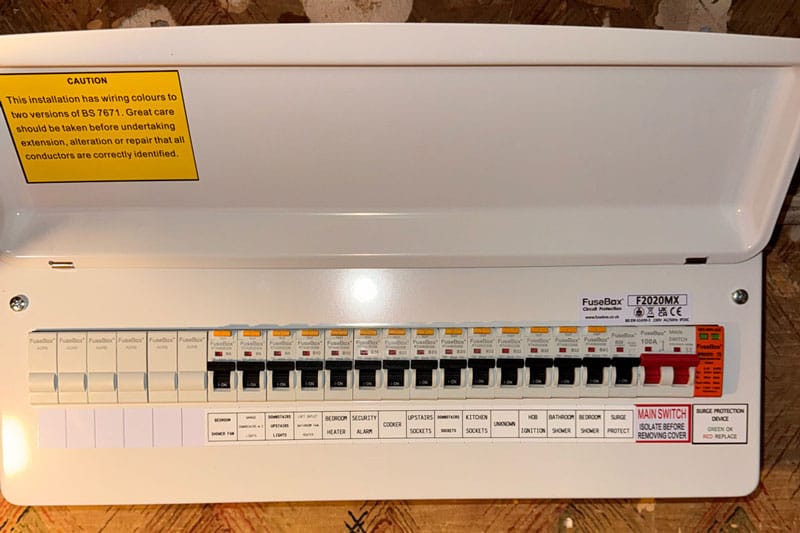
You’ve just had a new consumer unit installed, and now the Residual Current Devices (RCDs) keep tripping. It’s one of the most common calls we get after an upgrade, and the good news is it’s usually straightforward to diagnose. Here’s what’s going on and what to do about it.
Why RCDs are more sensitive after an upgrade
Modern RCDs are significantly more sensitive than the protection devices found in older consumer units. That’s the point: they’re designed to detect faults that older units would simply miss. So when a new unit is installed, it will sometimes pick up issues that were always there but were never tripping the old, less sensitive setup.
This means it’s doing exactly what it should and isn’t a fault with the new consumer unit.
The most common cause: appliance earth leakage
The most frequent culprit is an appliance that’s leaking a small amount of current to earth. This is known as earth leakage, and it’s perfectly normal for older appliances to develop it over time. The RCD detects this as a potential fault and disconnects the circuit.
To identify which appliance is causing the trip:
- Switch off and unplug everything on the affected circuit
- Reset the RCD
- Plug appliances back in one at a time
- When the RCD trips again, the last appliance you plugged in is likely the cause
Common culprits include washing machines, dishwashers, tumble dryers, older electric showers, and any appliance with a heating element. If the appliance is old or showing signs of wear, it may be time to replace it.
Wet weather and outdoor circuits
If your RCDs trip after heavy rain or during damp weather, moisture is the most likely cause. Water can work its way into outdoor sockets, external lighting fixtures, junction boxes, or garden power supplies, particularly if the fittings are older or the seals have deteriorated.
Again, the new consumer unit isn’t at fault here. It’s detecting a genuine issue that the previous unit was too insensitive to pick up.
If you suspect moisture is the cause, inspect any outdoor fittings for signs of water ingress. A temporary fix is to switch off the outdoor circuit at the consumer unit until the weather improves and the moisture clears. If the problem persists, the fittings or cabling will need to be inspected and potentially replaced.
What we test during an upgrade, and what we can’t
During a consumer unit upgrade, we carry out a full test of your electrical installation. This covers the wiring, earthing, and bonding: everything connected to the consumer unit itself.
What we cannot test at that stage is your individual appliances. Each appliance has its own internal wiring, and earth leakage from an appliance only becomes apparent once it’s plugged in and running. This is why RCD trips sometimes only emerge in the days after an upgrade rather than during the installation itself.
When to call us back
Most post-upgrade RCD trips can be resolved by identifying and replacing the faulty appliance. But if you have unplugged everything on a circuit and the RCD is still tripping, or if trips are happening across multiple circuits without an obvious cause, that’s when to get us back in. It may indicate an issue with the wiring itself that needs further investigation.
If you’re in Bristol and experiencing problems after a consumer unit upgrade, whether we installed it or not, get in touch and we’ll take a look.