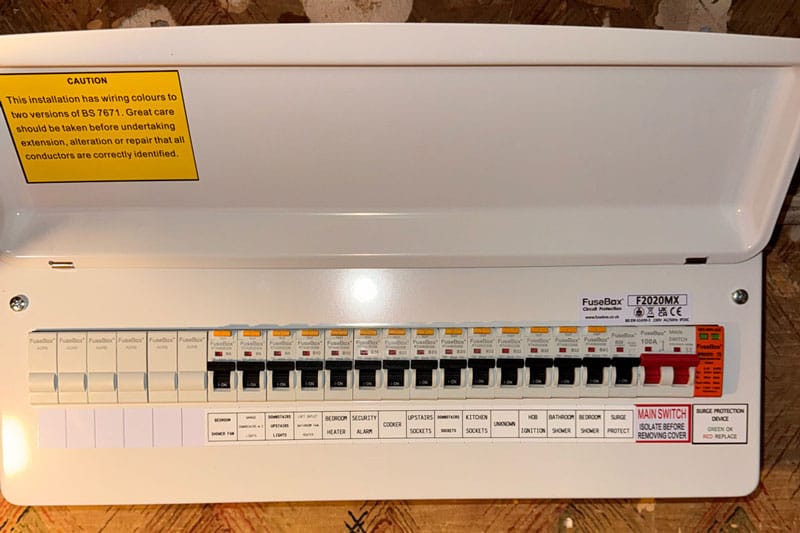
If you’ve been looking into a consumer unit upgrade, you’ve probably come across the terms Residual Current Device (RCD), Residual Current Breaker with Overcurrent protection (RCBO), and Arc Fault Detection Device (AFDD). They’re not the most intuitive acronyms, but understanding what they do makes it much easier to have a meaningful conversation with your electrician and to understand what you’re actually getting in a new consumer unit.
RCD: Residual Current Device
An RCD monitors the flow of electricity through a circuit. Under normal conditions, the current flowing out and the current flowing back should be equal. If the RCD detects an imbalance, which can happen when electricity is flowing somewhere it shouldn’t, such as through a person, it disconnects the circuit in milliseconds.
RCDs protect against two of the most serious electrical risks: electric shock and electrical fires caused by current leaking to earth. They’re a significant step up from the older rewirable fuses found in outdated fuse boxes, which offered no equivalent protection.
Under current wiring regulations, RCD protection is required for most circuits in a domestic property. If your existing consumer unit doesn’t have it, that’s one of the primary reasons an upgrade would be recommended.
RCBO: Residual Current Breaker with Overcurrent protection
An RCBO combines the function of an RCD with that of a circuit breaker. In a standard consumer unit setup using RCDs, one RCD covers a group of circuits, so if a fault is detected, everything on that group goes off. An RCBO protects each circuit individually.
This matters for two reasons. First, if a fault trips an RCBO, only that one circuit goes off rather than half the house. Second, because each circuit has its own dedicated protection, the cause of a trip is much easier to identify.
RCBOs cost more than standard RCDs, so a consumer unit fitted with individual RCBOs per circuit will carry a slightly higher price. For most homeowners, the added convenience and improved fault isolation makes it worthwhile, but we’ll always advise you on the right specification for your property and budget.
AFDD: Arc Fault Detection Device
AFDDs are the newest addition to domestic electrical protection. They detect arc faults: electrical discharges that occur when current jumps across a gap in damaged or deteriorated wiring. Arc faults are a leading cause of electrical fires, and they’re particularly common in older properties where wiring has been disturbed, pinched by furniture, or simply degraded over time.
Unlike RCDs and RCBOs, AFDDs are not yet a mandatory requirement in all domestic installations, though they are required in certain higher-risk situations such as student accommodation and houses of multiple occupation (HMOs). Many homeowners and landlords are choosing to include them in new consumer unit installations as an additional layer of protection, particularly in older Bristol properties where the wiring history may be less certain.
What does this mean for your consumer unit upgrade?
When we carry out a consumer unit upgrade, we’ll discuss the right specification for your property. At a minimum, your new unit will include RCD protection across all circuits. Depending on your property and your preferences, we may recommend individual RCBOs per circuit and, in some cases, AFDDs.
The goal is always the same: a consumer unit that gives your home the best practical protection within a sensible budget. We’ll always explain what we’re recommending and why, so you can make an informed decision.
If you’d like to know more about what a consumer unit upgrade involves for your specific property, get in touch for a free quote.